|
|
Project Name:
Drainage Advisory Services, a Component of The Left Bank Outfall Drain - Stage I Project
Country:
Pakistan
Project Location within Country:
Sindh
Professional Staff Provided by your Company:
No of Staff: Ten
Name of Client:
Department for International Development(DFID)
No of Person-months:
130
Starting Date: (Month/Year)
Aug 1996
Completion Date: (Month/Year)
April 1998
Name of Associated Firm(s), if any:
Mott MacDonald (UK)
No of Person-Months of Professional Staff Provided by Associated Firms(s):
No of Person-Months of Professional Staff Provided by Associated Firms(s):34 Expatriate Consultants60 Local Professional Staff
Names of Senior Staff (Project Director/Coordinator, Team Leader) Involved and Function Performed:
| Kamal S |
Social gender consultant; developing social gender strategy for DAS; supervising implementation; designing social gender research, supervision of data collection, data analysis, report writing and development of social strategy based on research; advise to WAPDA and designing and facilitation of workshops
|
| Khan L |
Intermediate gender specialist; developing detailed gender components for the three project districts; supervision of implementation; liaison and joint programmes with womens' groups, village organizations, NGOs and line departments related to social gender issues, formation and facilitation of women's groups |
| Maznani G |
Intermediate gender specialist; responsible for all social gender extension activities in one project district, supervision and implementation of all extension programmes, detailed documentation; organization of workshops, exhibitions, visits etc; supervision of gender field staff of government counterparts |
| Ismail H |
Intermediate gender specialist; responsible for all social gender extension activities in one project district, supervision and implementation of all extension programmes, detailed documentation; organization of workshops, exhibitions, visits etc; supervision of gender field staff of government counterparts |
| Ghori S |
Communications specialist; research relating to types and modes of communications with literate and non-lettered groups; development and implementation of the communications strategy for DAS; production of full range of materials including audio-visualize, and written material; assistance with organization of exhibitions, workshops etc, assessment of communications strategy and production of final reports, supporting volumes etc |
| Panhwar N |
Institutional specialist; formation of farmer organizations; liaison with NGOs line departments etc; developing linkages between farmer organizations, women's groups etc; developing and conducting research studies to develop the tile drainage component of project; organization and facilitation of participatory workshops, seminars
etc
|
| Quraishi N |
Assistant team leader; designing and development of training with farmers' organizations; organization of extension activities; contributing to strategies/policies for farmers' organizations and linkages with government line departments; supervision and implementation of extension programmes; trouble shooting |
Detailed Narrative Description of Project:
The left Bank Outfall Drain Stage I Project provides surface and sub-surface drainage for about 500,000 hectares of land in lower Sindh, within the districts of Nawabshah, Sanghar and Mirpurkhas. The first contract under the project was awarded in 1987. In Nawabshah, where construction works were given higher priority, sub-surface drainage works first became functional in August 1995, since when measurable benefits from drainage have been witnessed in many areas. Increasing numbers of drainage facilities in the remaining project components of Sanghar and Mirpurkhas are being commissioned and brought into operation in the run up to project closure in 1999.
Since the introduction of any rural infrastructure has a direct impact upon the lives of the rural population it was deemed important that beneficiaries be involved in the project starting from construction and continuing during operation. In 1995 a ' Communications Strategy ' was developed which included processes of; information dissemination to raise the awareness of prospective users or beneficiaries; consultation to seek the reactions of beneficiaries to the project; and encouraging participation in the shared management of project facilities. This communication strategy was to be implemented by the Drainage Advisory Service. Raasta Development Consultants joined Mott MacDonald at this stage. Raasta provided the bulk of the local professional staff, while expatriate staff and all local management and support staff were provided by Mott MacDonald.
From July 1996, DAS provided working linkages between farmer beneficiaries and staff of the implementing agency so that improvements suggested by local communities could be incorporated into the planning, construction, operation and maintenance of drainage works. Within the LBOD project, DAS designed and implemented a range of extension programmes to promote awareness of drainage benefits, practical involvement in project activities, and the development of both male and female farmer groups to share, with the government, the responsibility for the operation and maintenance of project drainage facilities.
The various components of the communications strategy were:·
Extension approaches; information about the project was communicated directly through discussions and meetings with community groups and indirectly through the print media and advertising hoarding. Information dissemination; since the majority of the project population is functionally illiterate, information about the project was reliant on strong visual images as a central means of communication. DAS had an in-house production unit which ensured the incorporation of feed-back from field-based extension staff into the cycle of development, testing, evaluation and revision of communication material. Consultation and participatory workshops; direct contact with both male and female farmer groups was established. This involved reconnaissance and informal visits and exhibitions; consultation workshops and consultation committees and women's action groups; and visits and joint tours to operating sites. -
Gender themes; In order to achieve the participation of women in all stages of the project, DAS developed a set of processes to streamline the work of their gender team. This included; research and documentation; analysis and diagnosis; formation of women's action groups; communication and feedback; participation and monitoring and impact assessment.
Organization for participation; DAS worked to develop and strengthen farmer groups to share operation and maintenance responsibilities. -
Participation of NGOs and CBOs; DAS built a network of collaborative relationships with formal, registered organizations active in the three component areas, as well as provincial and national NGOs working in the areas of environment, community participation, irrigation, drainage and agricultural development.
Detailed Description of Actual Services Provided by your Company:
There were three levels of Raasta's input into this long-term project: to develop and implement a participatory training programme for the DAS staff and community-based beneficiaries (men and Women); to assist in the planning and development of a programme for the design and production of a range of information materials about the project to be targeted at farmers of limited literacy and; assistance in the development and implementation of strategies for beneficiary participation, particularly women.
Specifically Raasta responsibilities on the project included: developing social gender strategy for DAS; supervising implementation; designing social gender research, supervision of data collection, data analysis, report writing and development of social strategy based on research; advise to WAPDA and designing and facilitation of workshops; formation of farmer organizations; liaison with NGOs line departments etc; developing linkages between farmer organizations, women's groups etc; developing and conducting research studies to develop the tile drainage component of project; organization and facilitation of participatory workshops, seminars etcDesigning and development of training with farmers' organizations; organization of extension activities; contributing to strategies/policies for farmers' organizations and linkages with government line departments; supervision of implementation; liaison and joint programmes with womens' groups, village organizations, NGOs and line departments related to social gender issues; trouble shooting; developing detailed gender components for the three project districts; formation and facilitation of women's groups; all social gender extension activities in each project district, supervision and implementation of all extension programmes, detailed documentation; organization of workshops, exhibitions, visits etc; supervision of gender field staff of government counterparts; research relating to types and modes of communications with literate and non-lettered groups; development and implementation of the communications strategy for DAS; production of full range of materials including audio-visualize, and written material; assessment of communications strategy and production of final reports, supporting volumes etc;
Selected Output
Final Report
- Executive Summary
- Main Report
- Additional Supporting Volumes
- SVI: Towards Shared Management: Processes for Consultation and Organization
- SV2: Working with Women: Gender, Development and Participation
- SV3: Working with Other Agencies
- SV4: Working with Communities: Testing Pilot Approaches·
- Archives Supplements
- AS 1: Resource Pack
- AS 2: Consultation and Organizations: Reports and Field Records
- AS 3: Social Gender Research and Programmes
- AS 4: Potential Partners: Notes on Collaborative Activities
- AS 5: Mirpurkhas Pilot Documents
- AS 6: DAS: Formulation and Progress
Working Papers Plan for Operation and Maintenance (POM)
- POM/ 1
Plan for Operation and Maintenance: Participation of Women
- POM/ 2
Plan for Operation and Maintenance: Cooperation and Partnership with NGOs
- POM/ 3
Plan for Operation and Maintenance: Beneficiary Participation
- POM/ 4
Plan for Operation and Maintenance: Rural Women and LBOD - An Exploratory Study Research Studies·
- Exploration of Landownership, Control and Transfers
- Knowledge Attitudes and Practices (KAP) Study in Relation to LBOD Inputs
- Gender Relations Within Family/Household· Relation Within and Between Different Social Groups
- A Rapid Assessment of Child Labour in the LBOD Project
Research Papers & Workshop Reports
A number of research papers and workshop reports were prepared for several occasions. The team has also represented LBOD on several seminars, conferences and training programmes.
Production of Information & Communications Materials
- Leaflets
- General Introduction of LBOD
- Benefits of LBOD-CAse Study evidence from Farmers
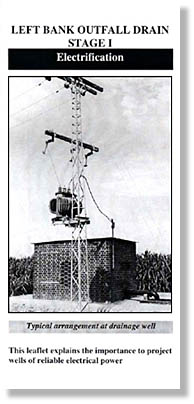
- Drilling Wells* Electrification
- Drainage and Scavenger Wells
- Damage to Drainage Wells
- Tidal Links
- Brochures
- Communication Strategy
- Role of Tidal Link in the LBOD-Stage 1 Project
- Videos
- A Story of Prosperity
- Damage to Drainage Embankments
- Tidal Links
- Children's Comic
- Coping with life and Salinity
Funding Source:
Department for International Development (DFID)
|
|